

Why Choosing the Right AC for a Southern California Home Is More Complex Than You Think
Choosing the right AC for a Southern California home is one of the most important decisions you’ll make as a homeowner — and it’s rarely as simple as picking the biggest unit you can afford. Southern California’s climate isn’t one-size-fits-all. A home in Carlsbad experiences very different cooling demands than one in Riverside or Palm Springs, and the wrong system can mean higher energy bills, uneven temperatures, and a unit that breaks down years ahead of schedule.
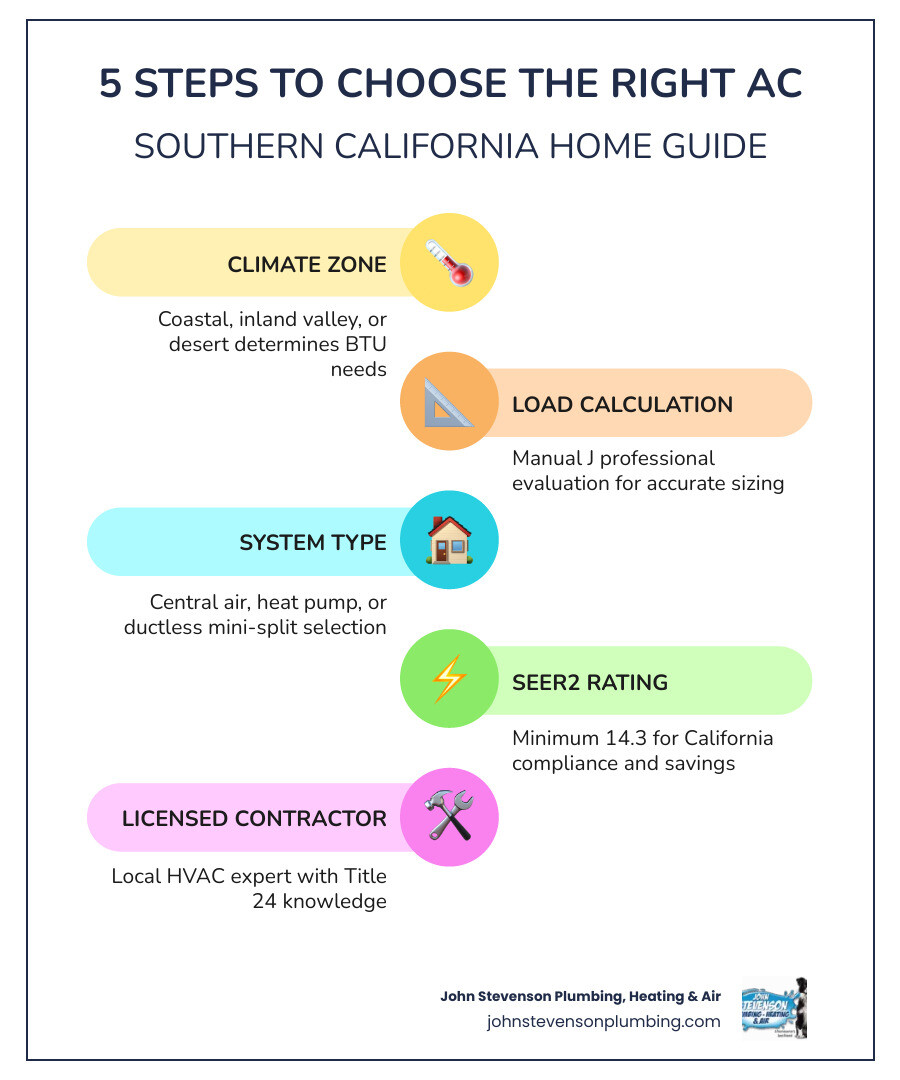
Here’s a quick overview of the key steps to choosing the right AC system for a Southern California home:
- Determine your climate zone — coastal, inland valley, or desert — since each has different BTU requirements per square foot.
- Calculate your cooling load using a professional Manual J load calculation, not just square footage.
- Choose the right system type — central air, heat pump, or ductless mini-split — based on your home’s layout and existing ductwork.
- Select the right efficiency rating — California requires a minimum of 14.3 SEER2 for new systems, but higher ratings deliver real long-term savings.
- Work with a licensed local HVAC contractor who understands Southern California’s Title 24 requirements and regional climate conditions.
Getting these decisions right from the start protects your comfort, your energy budget, and your investment. This guide walks you through every factor that matters — from sizing and system types to efficiency ratings and regional considerations — so you can make a confident, informed choice.
Choosing the right ac for a southern california home helpful reading:
Sizing Your System: How to Calculate the Perfect AC Tonnage
When it comes to air conditioning, there is a common and highly expensive myth that “bigger is always better.” Many homeowners believe that buying a larger system will cool their home faster and keep them more comfortable. In reality, an oversized system is just as problematic as an undersized one.
To achieve consistent cooling, maintain high energy efficiency, and maximize your system lifespan, your air conditioner must be sized with absolute precision. A system that is tailored perfectly to your home’s thermal dynamics will run optimal cooling cycles, manage indoor humidity levels, and experience fewer mechanical breakdowns over its lifetime.
Sizing and Capacity: Choosing the Right AC for a Southern California Home
Air conditioning systems are rated by their cooling capacity, which is measured in British Thermal Units (BTUs) and “tons.”
- What is a BTU? A BTU is the amount of heat energy required to raise the temperature of one pound of water by one degree Fahrenheit. In cooling terms, it represents how much heat the AC can remove from your home per hour.
- What is a Ton? In the HVAC world, one “ton” of cooling capacity equals 12,000 BTUs per hour. This terminology dates back to the days when ice was used for refrigeration — one ton of cooling is the amount of heat energy required to melt one ton of ice over a 24-hour period.
To give you a general idea of how residential systems map out, here are the standard industry capacity ranges:
- 1.5 Tons: 18,000 BTUs (typically covers 400 to 1,000 sq. ft.)
- 2 Tons: 24,000 BTUs (typically covers 700 to 1,200 sq. ft.)
- 2.5 Tons: 30,000 BTUs (typically covers 1,200 to 1,500 sq. ft.)
- 3 Tons: 36,000 BTUs (typically covers 1,500 to 2,000 sq. ft.)
- 3.5 Tons: 42,000 BTUs (typically covers 2,000 to 2,400 sq. ft.)
- 4 Tons: 48,000 BTUs (typically covers 2,000 to 2,500 sq. ft.)
- 5 Tons: 60,000 BTUs (typically covers 2,500 to 3,000+ sq. ft.)
While square footage guidelines are a helpful starting point, they should never be the sole basis for your purchase. If you rely on basic square footage rules of thumb, you risk missing critical variables like ceiling heights, window types, and regional climate differences. For a deeper dive into these calculations, check out our guide on How To Calculate Required Ac Size In 4 Easy Steps.
The Role of Manual J Load Calculations
The only truly accurate way to determine the correct AC size for your home is through a professional Manual J load calculation. Developed by the Air Conditioning Contractors of America (ACCA), the Manual J protocol is the industry gold standard for calculating a home’s precise thermal load.
Unlike basic square footage calculators, which carry a massive 30% margin of error, a Manual J load calculation provides a highly precise estimate with roughly a 5% margin of error. During a professional evaluation, we analyze a wide range of structural and environmental factors, including:
- The exact R-value of your wall, attic, and floor insulation.
- The number, size, orientation, and U-factor of all windows and glass doors.
- Local climate data and regional design temperatures.
- The orientation of your home relative to the sun.
- Air infiltration and duct leakage rates.
- Heat generated by internal appliances, lighting, and the number of regular occupants.
By taking these details into account, we can determine the exact cooling load of your home and match it with a system of the correct capacity (often referred to as a Manual S equipment selection).
What Happens If Your AC Is Too Big or Too Small?
Installing an incorrectly sized air conditioner can lead to severe comfort and financial consequences.
- If your AC is too big (oversized): It will cool your home incredibly fast, but this leads to a highly destructive process called short cycling. Because the system reaches the thermostat setpoint so quickly, it shuts off before completing a full, healthy cooling cycle. This rapid turning on and off prevents the system from running long enough to pull moisture out of the air, leaving your home feeling cold and clammy. Short cycling also causes massive spikes in your energy bills, creates uneven temperatures (hot and cold spots), and subjects the compressor to intense wear and tear, drastically shortening its lifespan.
- If your AC is too small (undersized): It will run non-stop in a desperate, futile attempt to reach your desired temperature during hot summer days. This constant operation leads to exceptionally high utility bills, rapid component wear, and premature system burnout.
According to extensive industry data, about 19% of central AC systems encounter at least one major mechanical issue within their first several years of service, and 24% of those problematic units stop working as well as they should or fail altogether. In a vast majority of these cases, improper sizing and poor installation quality are the direct culprits.
Key Factors in Choosing the Right AC for a Southern California Home
Southern California features some of the most diverse microclimates in the country. A home in coastal Carlsbad experiences vastly different environmental demands than a home inland in Escondido, Ramona, or Yorba Linda. To choose the right system, we must look closely at how your regional climate, home layout, solar heat gain, and airflow patterns intersect.
Climate Zones: Coastal vs. Inland vs. Desert
When choosing the right AC for a southern california home, your geographic location dictates your baseline cooling demand.
- Coastal Zone (e.g., Carlsbad, Encinitas, Solana Beach, Del Mar, La Jolla): Coastal homes benefit from a mild marine influence. Summers are moderate, and winters are highly temperate. In these areas, the AC may only run 30 to 50 days out of the entire year. The primary challenge here is humidity control rather than extreme heat. Sizing needs are typically lower — around 20 to 22 BTUs per square foot is often sufficient.
- Inland Valley Zone (e.g., Escondido, Poway, San Marcos, Irvine, Yorba Linda): Just a few miles inland, the ocean’s cooling breeze fades. Summer temperatures regularly climb into the 90s and low 100s, while winter nights can get surprisingly chilly. Homes in these areas require robust cooling capacities (22 to 26 BTUs per square foot) and highly efficient systems to manage long summer afternoons.
- Desert/High-Heat Zone (e.g., Ramona, Pauma Valley): These areas experience extreme temperature swings, with blistering summer heat that demands continuous cooling. Sizing requirements here are the highest, often needing 26 to 28+ BTUs per square foot, along with heavy-duty systems designed to withstand intense, prolonged thermal stress.
Home Construction, Insulation, and Sun Exposure
Beyond geography, the physical construction of your home plays an enormous role in heat retention and transfer.
- Insulation Quality: Older, historic homes in coastal communities often have minimal wall insulation and single-pane windows. These homes lose cool air rapidly and require a larger cooling capacity than a modern, tightly sealed home built to strict California Title 24 standards.
- Window Orientation and Solar Heat Gain: Homes with large, west- or south-facing windows receive intense afternoon sun. This solar heat gain can raise your indoor temperature dramatically, requiring zoned cooling or a slightly larger system to offset the localized heat.
- Ductwork Integrity: Your ductwork is the circulatory system of your HVAC unit. Industry studies show that unsealed, leaky ducts can easily waste 20 to 30 percent of the energy used to run your AC system. If your ducts are routed through a scorching attic without proper sealing and insulation, your AC will have to work significantly harder to cool your living spaces.
System Types: Traditional Central Air vs. Heat Pumps
Once you know the required capacity for your home, the next step is choosing the technology that will deliver that cooling. Today, homeowners are no longer restricted to traditional central air conditioners. Modern ducted heat pumps and ductless mini-splits offer incredible energy efficiency and system versatility.
| Feature | Traditional Central AC | Ducted Heat Pump | Ductless Mini-Split |
|---|---|---|---|
| Primary Function | Cooling only (requires separate furnace for heat) | Both heating and cooling in one system | Both heating and cooling in one system |
| Ductwork Required | Yes | Yes | No (uses indoor air handlers) |
| Zoning Capabilities | Limited (unless using mechanical dampers) | Moderate | Excellent (room-by-room control) |
| Energy Efficiency | Standard to High | Very High | Exceptional |
| Best For | Homes with existing, high-quality ducts | Homes looking to replace both AC and furnace | Older homes, additions, or zone-specific comfort |
Efficiency and Technology: Choosing the Right AC for a Southern California Home
As you shop for a new system, you will encounter several key efficiency metrics and technological features:
- SEER2 Ratings: The Seasonal Energy Efficiency Ratio 2 (SEER2) measures the cooling efficiency of an AC or heat pump over an entire cooling season, accounting for real-world static pressure in ductwork. The higher the SEER2 rating, the less electricity the system uses. While California’s legal minimum for new split systems is 14.3 SEER2, high-efficiency models can reach 20+ SEER2, providing substantial utility savings.
- Variable-Speed Compressors: Traditional single-stage air conditioners operate like a light switch — they are either 100% on or completely off. Variable-speed (inverter-driven) compressors, however, operate like a dimmer switch. They can modulate their capacity anywhere from 25% to 100% to match your home’s exact real-time cooling needs. This continuous, low-speed operation eliminates temperature swings, improves humidity extraction, and reduces energy consumption.
- Smart Thermostat Integration: Upgrading to a smart or programmable thermostat allows you to optimize your cooling schedules. Setting your thermostat at the right temperature when you are away can reduce your annual cooling costs by about 10%.
- The Fan Effect: Integrating box or ceiling fans into your daily routine can make you feel 3°F to 4°F cooler through wind chill, allowing you to set your thermostat higher and reduce overall AC energy use.
Comparing Central Air and Ductless Mini-Splits
For homes with existing, well-designed ductwork, a traditional central air conditioner or a ducted heat pump is often the most straightforward replacement option. However, many older homes in our coastal and historic neighborhoods were built without ductwork.
Retrofitting these properties with heavy sheet-metal ducts can be incredibly invasive, destroying beautiful architectural details and taking up valuable closet space. In these scenarios, ductless mini-split systems are an absolute game-changer. Mini-splits connect an outdoor condenser to one or more elegant indoor air handlers via small, non-invasive refrigerant lines. They offer incredible zoning capabilities, allowing you to customize the temperature of individual rooms.
If you are weighing these options, we have compiled several comprehensive guides to help you decide:
- Take a look at The Definitive Guide To Central Ac Vs Ductless Mini Split Comparison for an in-depth breakdown.
- Read Mini Split Vs Central Air Which Is Better to weigh the pros and cons of each technology.
- Explore All About Mini Split Suitability For Whole House Cooling to see if a ductless setup can handle your entire home.
- Learn about historic home solutions in A Practical Guide To Central Air Vs Mini Split For Older Homes.
- Find the perfect layout with All About Best Rooms For A Mini Split System.
- Calculate your hardware needs using How To Calculate Needed Mini Split Heads In 5 Simple Steps.
Selecting the Best AC Features and Brands for SoCal Climates
When selecting a brand and model for your Southern California home, it is vital to look beyond marketing slogans. Focus instead on manufacturer build quality, warranty terms, and specific engineering features that address our unique regional challenges.
Key Features to Look For When Buying a New AC Unit
To ensure your new air conditioner is future-proof, reliable, and quiet, pay close attention to the following technical details:
- Refrigerant Type: The HVAC industry is currently undergoing a major environmental transition. Older R-410A systems are phasing out in favor of next-generation, low-global-warming-potential (GWP) refrigerants like R-32. Choosing a system designed for these modern refrigerants ensures your unit remains easy and affordable to service for decades to come.
- Low Decibel (dB) Ratings: Many homes in planned Southern California communities (such as those in Ladera Ranch, Aliso Viejo, or Irvine) are built close to property lines. A loud, clanging AC unit can easily disrupt your sleep and annoy your neighbors. Look for high-efficiency units with sound-dampening compressor blankets and swept-wing fan blades that operate below 65 dB.
- Corrosion-Resistant Coatings: If you live within five miles of the ocean (in Carlsbad, Oceanside, Del Mar, or Newport Beach), salt air corrosion is a major threat. Salt can rapidly eat away at aluminum condenser fins, reducing heat transfer and causing premature system failure. Look for brands that offer specialized marine-grade, anti-corrosion coil coatings (often called Blue Fin or Gold Fin technology) to protect your investment.
For a complete checklist of what to evaluate during your purchase, read our guide on What To Look For When Buying A New Ac Unit.
Regional Recommendations: San Diego, Orange County, and Inland Areas
Because microclimates vary so widely across our service areas, we tailor our system recommendations to your specific neighborhood:
- San Diego Coastal Areas (e.g., Carlsbad, Del Mar, La Jolla, Encinitas): For these temperate coastal zones, we highly recommend high-efficiency heat pumps. Because heating demands are so mild, a heat pump can handle both your summer cooling and your light winter heating needs with incredible efficiency. Marine-grade coil coatings are highly recommended here to combat salt air.
- Orange County Suburbs (e.g., Irvine, Mission Viejo, Yorba Linda, Lake Forest): These areas experience hot summer afternoons but benefit from cooler evening air. A two-stage or variable-speed split system is the sweet spot here, offering maximum comfort during peak heat while running quietly and efficiently on lower stages during milder days.
- Inland San Diego County (e.g., Escondido, Ramona, Poway): With summer temperatures frequently pushing past 100°F, inland homes need maximum cooling capacity and top-tier efficiency. We recommend high-SEER2 variable-speed systems, paired with zoned ductwork or multi-zone mini-splits, to keep energy bills manageable while keeping every corner of your home perfectly cool.
Frequently Asked Questions About Southern California AC Sizing
What is the minimum SEER2 rating required in California?
Under California’s Title 24 energy code, all new split-system central air conditioners installed in the southern region must meet a minimum efficiency standard of 14.3 SEER2 (which is equivalent to roughly 15 SEER under the old rating system). Investing in a system with a higher rating, such as 16 to 20+ SEER2, can deliver significant long-term energy savings, especially in hotter inland areas.
How much energy can be saved by sealing ductwork?
Properly sealing and insulating your ductwork can prevent wasting 20 to 30 percent of the energy used to run your air conditioner. Air leaks in your ducts allow conditioned air to escape into your attic or crawlspace, forcing your AC to run longer and work harder to cool your home. Sealing these leaks optimizes airflow and immediately lowers your monthly utility bills.
Should I choose a heat pump or a traditional AC for my Carlsbad home?
For Carlsbad and surrounding coastal communities, a heat pump is almost always the superior choice. Because our winters are incredibly mild, you do not need a heavy-duty gas furnace. A heat pump uses advanced refrigeration technology to cool your home in the summer and reverses the process to provide highly efficient warmth in the winter. In fact, heat pumps can reduce your electricity use for heating by about 75% compared to traditional electric resistance heating, making them an incredibly eco-friendly, dual-purpose comfort solution.
Conclusion
Choosing the right AC for a Southern California home is a major decision that requires looking at the big picture — from precise load calculations and climate zones to system types and efficiency ratings. There is no single “perfect” system, only the system that is perfectly tailored to your unique home, lifestyle, and local microclimate.
At John Stevenson Plumbing, Heating & Air Conditioning, Inc., we are dedicated to helping our neighbors throughout Carlsbad, San Diego County, and Orange County find the ideal home comfort solutions. Our highly trained, certified technicians do not rely on guesswork or simple square-footage rules. We perform thorough diagnostics and precise calculations to ensure your new system is sized and installed flawlessly.
When you partner with us, you are protected by our premier 5-Star Service Guarantee:
- Thorough Diagnostics: We assess your home’s unique thermal dynamics, insulation, and ductwork to find the absolute best setup for your needs.
- Upfront Pricing: You will always know the exact cost of the job before any work begins — no hidden fees, no surprises.
- Certified Techs: Our clean, professional, and highly trained technicians perform every installation to the highest industry and Title 24 standards.
- 24-Hour Satisfaction Check-ins: We follow up with you a day after your installation to ensure your new system is running perfectly and you are completely thrilled with our service.
Don’t leave your summer comfort and energy savings to chance. Schedule your professional AC installation with our Carlsbad experts today and experience the peace of mind that comes with a truly customized cooling solution.